Tocotrienols: A Promising Bioactive in Health Research
Palm oil is one of the richest natural sources of tocotrienols—a lesser-known form of vitamin E that has attracted growing scientific interest. Studied for their antioxidant and anti-inflammatory properties, palm tocotrienols are increasingly recognised for their potential relevance across a wide range of health areas.

What are tocotrienols?
Vitamin E consists of two main groups: tocopherols and tocotrienols. While tocopherols are more commonly found in many vegetable oils, tocotrienols occur in particularly high levels in palm oil.
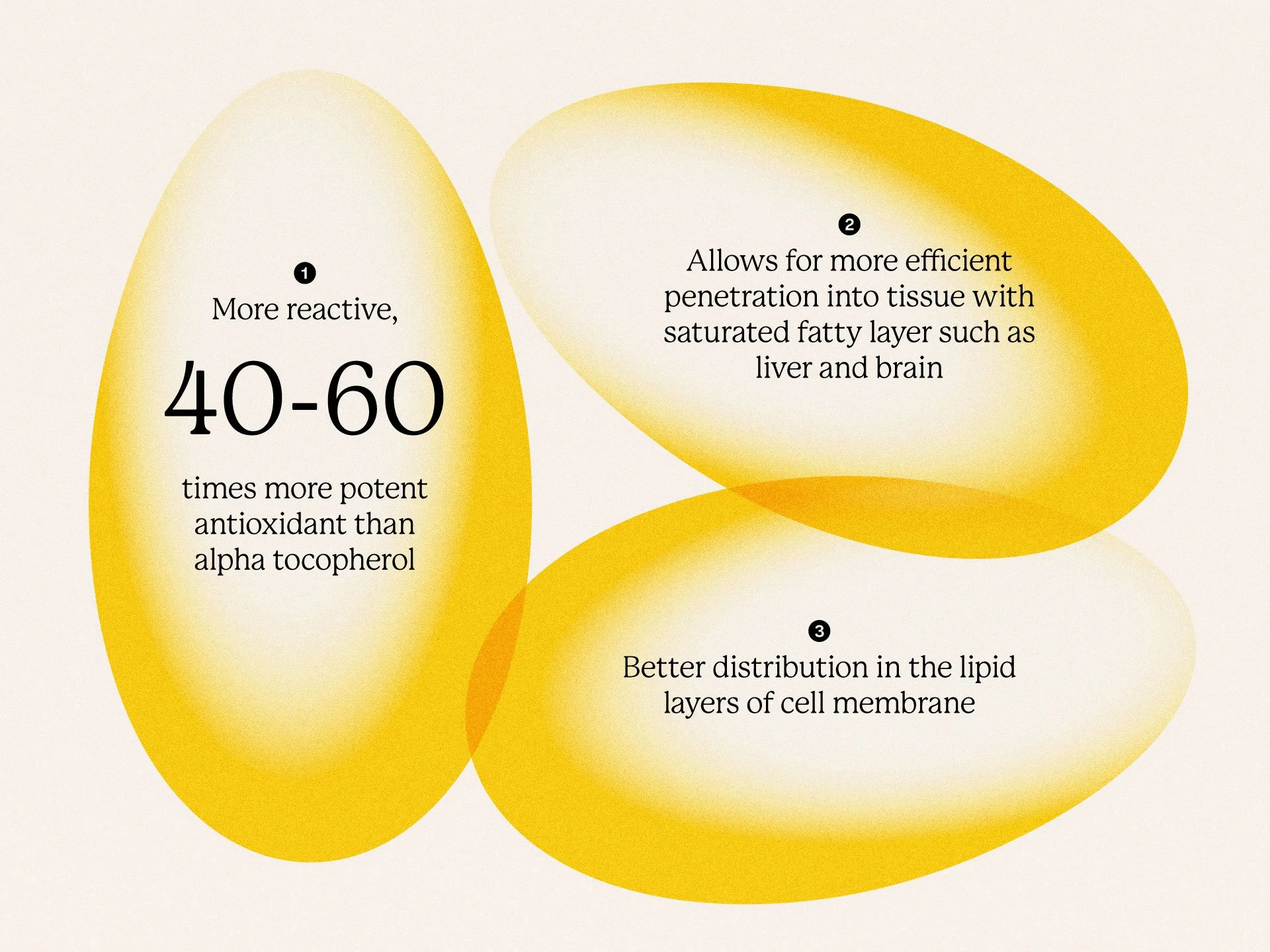
This distinction matters because tocotrienols possess biological properties that differ from, and in some cases exceed, those of tocopherols. One of these differences lies in their unsaturated side chain, which allows more efficient penetration into tissues with saturated fatty layers, such as the brain and liver. This structural feature is part of what makes tocotrienols a notable focus in nutrition and health research.
Advantages of Unsaturated Side Chain
Why are palm tocotrienols gaining attention?
Palm tocotrienols are of interest not only because they act as antioxidants, but also because they are being studied for broader biological functions. Research has explored their possible role in supporting the body against oxidative stress, inflammation, and cellular damage.
This has positioned tocotrienols as one of the more distinctive phytonutrients found in palm oil — with potential relevance in both preventive health and longer-term wellbeing.
A growing area of health research
Scientific interest in palm tocotrienols spans a wide range of health topics. These include brain and nerve health, cardiovascular health, bone strength, skin health, immune function, and metabolic wellbeing.
In neuro health, tocotrienols have been studied for their possible protective effects on nerve cells and their role in reducing inflammatory activity. In cardiovascular health, they have also been explored for their potential to support healthy cholesterol balance and help reduce processes linked to vascular stress.
Beyond basic nutrition
What makes tocotrienols especially notable is that they are being studied as more than just a nutrient. Researchers are increasingly interested in how these compounds may contribute to the body’s resilience at a cellular level.
This has led to growing discussion around palm tocotrienols in relation to healthy ageing, inflammation-associated conditions, and broader health maintenance.
A measured but promising perspective
While current findings are encouraging, tocotrienols should not be viewed as a stand-alone solution or miracle ingredient. Much of the research is still evolving, and some areas require stronger clinical evidence.
Even so, the body of research to date suggests that palm tocotrienols are a promising bioactive compound — one that adds depth to the understanding of palm oil beyond its role as a cooking oil alone.
Palm tocotrienols represent a valuable area of study within the wider field of nutrition science. Their significance lies in the growing evidence that naturally occurring compounds in palm oil may offer benefits that extend beyond basic nutrition, particularly in the context of long-term health and wellbeing.
ReferenceBryce Wylde, Consumer Perception And Pick-up: Where We Are At And Where We Should Be. Paper presented at the Palm International Nutra-Cosmeceutical Conference (PINC 2017), 31st July – 1st August 2017, Le Meridien, Putrajaya.
Dr. Sharmili Vidyadaran, Tocotrienols and their effects on microglia: implications for brain inflammatory conditions. Paper presented at the Palm International Nutra-Cosmeceutical Conference (PINC 2017), 31st July – 1st August 2017, Le Meridien, Putrajaya.
Prof. Dr. Ima Nirwana Soelaiman, Effect of individual tocotrienol isomers on bone cells in a 3D cell culture system. Paper presented at the Palm International Nutra-Cosmeceutical Conference (PINC 2017), 31st July – 1st August 2017, Le Meridien, Putrajaya.
Dr. Nur Azlina Mohd. Fahami, Palm Vitamin E: A Potential Therapy for Peptic Ulcer Disease. Paper presented at the Palm International Nutra-Cosmeceutical Conference (PINC 2017), 31st July – 1st August 2017, Le Meridien, Putrajaya.
Prof. Dr. Suzana Makpol, Tocotrienool Promotes Myogenic Differentiation in the Prevention of Replicative Senescence of Myoblasts. Paper presented at the Palm International Nutra-Cosmeceutical Conference (PINC 2017), 31st July – 1st August 2017, Le Meridien, Putrajaya.
Dr. Patrick Ling , Dissecting the Mechanism Responsible for the Anti-Cancer Stem Cell Properties of Gamma-Tocotrienol. Paper presented at the Palm International Nutra-Cosmeceutical Conference (PINC 2017), 31st July – 1st August 2017, Le Meridien, Putrajaya.