Palm Olein and Blood Lipids: What the Evidence Suggests
Palm olein is the liquid fraction of palm oil and is widely used as a cooking oil in many parts of the world. In discussions around cholesterol and cardiovascular health, it is best understood through its fatty acid composition, its role in the diet, and the evidence comparing it with other edible oils.

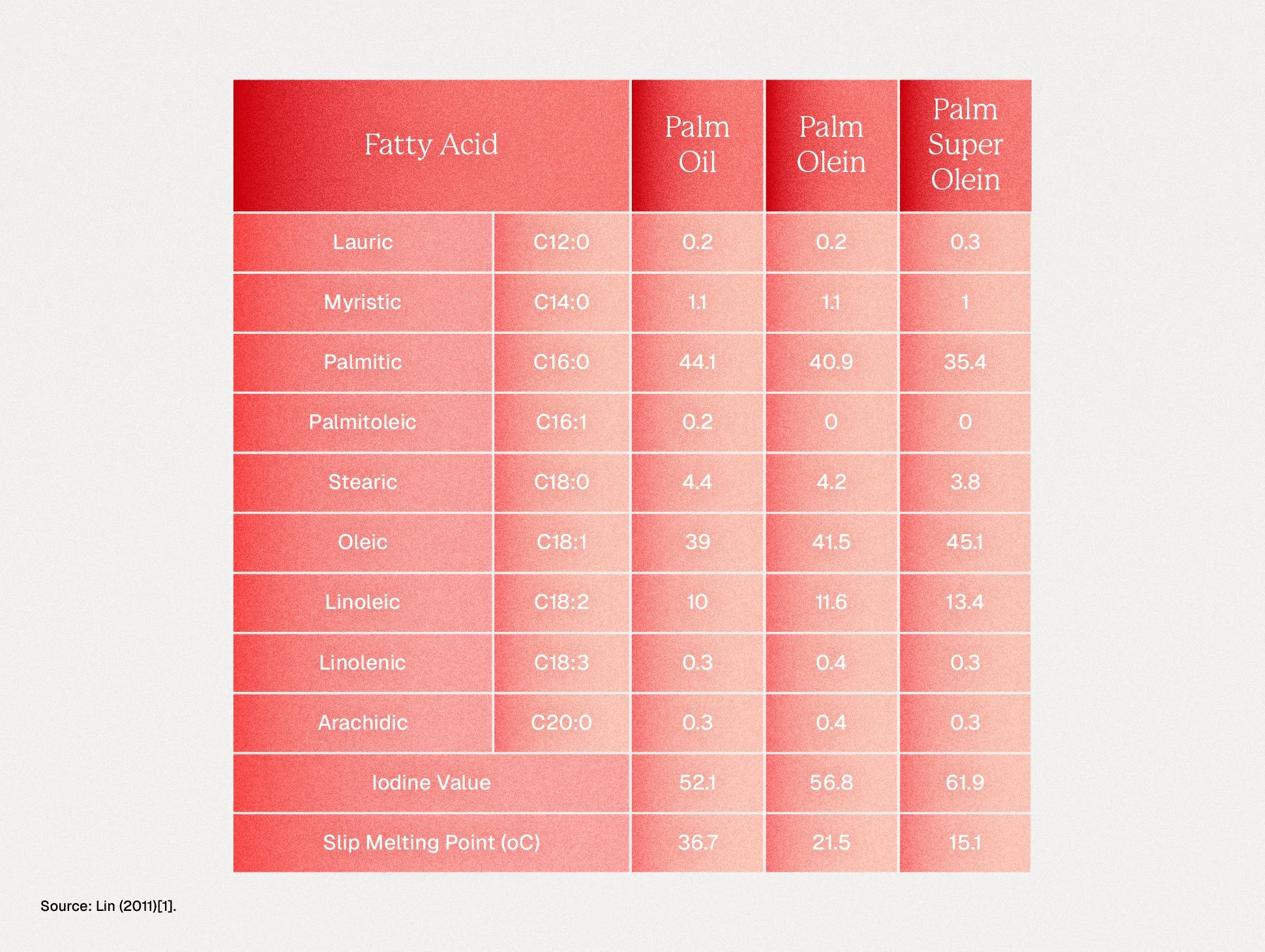
Palm olein is derived from palm oil through fractionation and contains a relatively higher proportion of monounsaturated oleic acid than palm oil itself. It can also be further fractionated into palm super olein, which has an even higher oleic acid content and remains fluid at lower temperatures.
This composition makes palm olein particularly relevant as an everyday edible oil, especially in regions where it is commonly used for home cooking and food service.
Palm olein is well suited for frying due to its low level
of polyunsaturated linoleic acid.
Why is it often discussed in relation to cholesterol?
Palm olein is sometimes viewed critically because it contains saturated fatty acids. A fuller understanding, however, requires looking at its overall fatty acid profile rather than judging it by category alone.
Palm olein is cholesterol-free and has a balanced fatty acid profile, composed of approximately equal amounts of saturated and unsaturated fatty acids, including oleic acid (monounsaturated) and linoleic acid (polyunsaturated).
Fatty Acid Composition of Plan Oil, Palm Olein and Palm Super Olein (% by weight)
What comparative studies have found?
Comparative research has examined palm olein alongside saturated-fat-rich fats as well as oils rich in monounsaturated fatty acids (MUFA) and polyunsaturated fatty acids (PUFA). In these comparisons, palm olein showed lower total cholesterol and LDL-cholesterol than certain saturated-fat-rich fats, while producing similar effects to MUFA- and PUFA-rich oils on several blood lipid markers.
Increases in HDL-cholesterol were also found to be more apparent after palm olein consumption than after some MUFA-rich oils. Taken together, these findings suggest that palm olein does not show a uniquely adverse lipid profile when assessed against other commonly used edible oils.
Why composition matters?
The physicochemical profile of palm olein helps explain why its nutritional effects may differ from assumptions based only on the word “saturated”. Its characteristics include a distinct triglyceride structure and meaningful amounts of oleic and linoleic acids.
This reinforces the importance of looking at overall fatty acid composition, rather than relying on broad generalisations about a single oil.
Putting palm olein into dietary context?
Palm olein can sit within a balanced diet, particularly when overall fat intake remains within recommended ranges. Its suitability for frying also adds to its relevance as a practical everyday cooking oil.
As with any edible oil, context matters. Broader dietary patterns, total fat intake, and the food environment in which the oil is used all shape how it should be understood in relation to health.
Palm olein is best discussed through evidence rather than assumption. Its blood lipid effects are comparable to those of other unsaturated vegetable oils, while its composition and cooking performance continue to support its place as a practical and widely used edible oil.
ReferenceLin, S.W., 2011. Palm Oil. In F. D. Gunstone (Ed.), Vegetable oils in food technology: Composition, properties and uses (2nd ed.). West Sussex, England: Blackwell Publishing Ltd. pp.25.
National Health and Morbidity Survey (NHMS2017): Adolescent Nutrition Survey 2017. Institute for Public Health, National Institutes of Health, Ministry of Health Malaysia, Kuala Lumpur.
Voon, P.T., Lee, S.T., Ng, T.K.W., Ng, Y.T., Yong, X.S., Lee, V.K.M. and Ong, A.S.H., 2019. Intake of Palm Olein and Lipid Status in Healthy Adults: A Meta-Analysis. Advances in Nutrition.
Codex standard for named vegetable oils, Codex-Stan 210–1999. Revisions 2001, 2003, 2009, Amendment 2005, 2011, 2013, 2015 and 2019.
Sundram, K., Ismail, A., Hayes, K.C., Jeyamalar, R. and Pathmanathan, R., 1997. Trans (elaidic) fatty acids adversely affect the lipoprotein profile relative to specific saturated fatty acids in humans. The Journal of nutrition, 127(3), pp.514S-520S.
French, M.A., Sundram, K. and Clandinin, M.T., 2002. Cholesterolaemic effect of palmitic acid in relation to other dietary fatty acids. Asia Pacific journal of clinical nutrition, 11, pp.S401-S407.